1. Introduction – What Are MUDs and Why Should You Know Their History?
Anyone searching today for terms like MMO, MMORPG, online RPG, or "best alternative to World of Warcraft" will land on graphical worlds like Final Fantasy XIV, Elder Scrolls Online, or Guild Wars 2. Vast 3D landscapes, raids, dungeons, classes, guilds — the full package. What is almost always overlooked: the entire design DNA of modern MMORPGs did not originate in a 3D engine. It was written in text.
MUDs — Multi User Dungeons — are the original form of the persistent online world. Multiple players simultaneously, in real time, with chat, group play, PvE, PvP, roleplaying, and long-term progression. Not a single pixel, no textures, no polygon graphics. Just words. And yet everything that defines an MMORPG.
At the same time, MUDs stand in a second tradition: tabletop roleplaying. Dungeons & Dragons and The Dark Eye (Das Schwarze Auge) shaped the vocabulary of classes, quests, dungeon crawls, and "story first." MUDs transferred this principle into a networked medium: the dungeon became the server, the gaming table became an online community, and the game master became wizards and admins.
This article traces the history of MUDs from the text adventures of the 1970s to the present day 2026 — with verified facts, source references, timelines, and the question of why this format, now over 48 years old, is more relevant than ever in 2026.
1.1 What Exactly Is a MUD? — A Definition for Beginners
A MUD in the "GnomeMUD" client — text commands guide the player character through a described world.
Image: Zeth, CC BY-SA 3.0, via Wikimedia Commons
A MUD is a text-based multiplayer online role-playing game. Players connect via a client — formerly Telnet, today often a browser client — and control their character through text input: look, north, say Hello!, kill rat. The world responds with descriptions: rooms, NPCs, monsters, items, quests. Everything in real time, everything persistent — the world keeps running even when you're offline.
This is exactly the principle that World of Warcraft, Elder Scrolls Online, or Guild Wars 2 use — except that their output consists of polygons rather than sentences. The underlying structure (characters, levels, groups, economy, chat, guilds, PvP zones) is remarkably identical.
Did you know? The term "MUD" stands for Multi User Dungeon and traces directly back to the first MUD from 1978. The developers simply called it "MUD" — a nod to Dungeon, the nickname for the text adventure Zork that was circulating at universities at the time.
2. The Precursors — Text Adventures and the Idea of a Shared World (1970–1978)
Before MUDs existed, there were text adventures: interactive stories in which players entered commands via a text parser and explored the world. Two games stand out because they lead directly into MUD history.
2.1 Colossal Cave Adventure (1976)
Will Crowther's original version of ADVENT (1975–76) on a PDP-10 — the ancestor of all text adventures and MUDs.
Image: Will Crowther, Public Domain, via Wikimedia Commons
In 1975, Will Crowther, a programmer at BBN Technologies and avid caver, began writing a program that simulated Mammoth Cave in Kentucky — augmented with fantasy elements from Dungeons & Dragons. The result, Colossal Cave Adventure, is widely considered the first text adventure ever made.
In 1976, Don Woods at Stanford University significantly expanded the game: more rooms, more puzzles, more fantasy. This version spread via the ARPANET — the precursor network of today's internet — and was played at universities worldwide. Adventure proved: pure language can create worlds that captivate players for hours.
The gameplay was deceptively simple: the player read a room description, typed commands like go north or take lamp, and navigated through a network of caves, canyons, and underground lakes. Despite its simplicity — no image, no sound, just text on a terminal — it created a gameplay experience that was deeply addictive. Crowther's caving experience provided the geography; Tolkien and D&D provided the fantasy elements: dwarves, dragons, magical items. This recipe became the blueprint for everything that followed.
2.2 Zork and the Birth of Infocom (1977–1980)
Inspired by Adventure, students at MIT developed the text adventure Zork starting in 1977 — significantly more expansive, with a more sophisticated parser and a dry humour that became its trademark. Zork was commercially distributed by Infocom starting in 1980 and shaped an entire generation of gamers.
Both Adventure and Zork were single-player experiences. But they proved two things that would be crucial for MUDs: text can be immersive. And a "dungeon" is not a picture — it is a system of rooms, rules, and possibilities. Only one ingredient was missing: other people.
2.3 The Pen-&-Paper Influence
Many early developers were tabletop RPG players. Dungeons & Dragons, published in 1974 by Gary Gygax and Dave Arneson, provided the vocabulary: classes, levels, hit points, experience points, dungeons, quests. In text adventures, this became puzzle exploration; in MUDs, it became a social world — forming groups, playing roles, negotiating conflicts. Like at the gaming table, only online.
2.4 PLATO — Multiplayer Dungeons Before MUD1 (1977–1979)
Students at PLATO terminals in the mid-1970s — on this system, the first graphical multiplayer RPGs were created.
Image: The CRPG Book Project by Felipe Pepe, CC BY-NC 4.0
Even before Roy Trubshaw wrote MUD1 in 1978, genuine multiplayer RPGs already existed on the PLATO system at the University of Illinois — albeit on a closed network that, with its dedicated plasma display terminals and touchscreens, was far ahead of its time. PLATO connected hundreds of institutions across North America and Europe via dedicated lines and satellite links.
In 1977, Jim Schwaiger released Oubliette — considered by many historians to be the first graphical multiplayer RPG. The depth was astonishing for 1977: 15 races (including humans, elves, hobbits, orcs, uruk-hai, and pixies) and 15 classes (from priest to ninja to samurai). Players formed groups of up to 15, met in virtual taverns, and explored dungeons together in rudimentary first-person perspective. There were guilds, a detailed magic system, the ability to tame monsters — and even gambling mini-games like blackjack, dice games, and cockroach races. Oubliette directly inspired the Wizardry series (1981), which in turn influenced the entire Japanese RPG tradition — a line stretching all the way to Final Fantasy and Dragon Quest.
In 1979 came Avatar, created by high school students Bruce Maggs, Andrew Shapira, and Dave Sides. Avatar offered 2.5D graphics, groups of up to 15 players, and became the most-played game in PLATO history — Avatar alone consumed approximately 600,000 usage hours. In total, the PLATO mainframes logged over 10 million usage hours between 1978 and 1985, with an estimated 20% going to games. At peak times, between ten and a hundred developers were working simultaneously on dungeon games in the system, often side by side in Room 165 of the CERL laboratory. Both Avatar and Oubliette can still be played today on emulated PLATO mainframes at cyber1.org.
The crucial difference from MUD1: PLATO games were tied to their proprietary network and could not leave it. MUD1, by contrast, ran on open networks — and that is precisely what made it the namesake of an entire genre.
3. The Birth: MUD1 — The First Multi User Dungeon (1978–1985)
Spells from MUD1, from Duncan Howard's book "An Introduction to MUD" (1985).
Image: The CRPG Book Project by Felipe Pepe, CC BY-NC 4.0
In the autumn of 1978, Roy Trubshaw, a student at the University of Essex in England, began writing a program that would bring multiple players together simultaneously in a virtual world. Trubshaw programmed the first version in MACRO-10, the assembly language of the university's DEC PDP-10 mainframe. Within a few hours he had a working prototype; by Christmas 1978, a playable second version existed.
Trubshaw simply called his program "MUD" — Multi User Dungeon. It was the proto-MMORPG moment: for the first time, multiple people could simultaneously explore a networked fantasy world, chat, fight, trade, and solve puzzles — long before Ultima Online, EverQuest, or World of Warcraft. While graphical multiplayer dungeons already existed on the PLATO system (see chapter 2.4), those were tied to a closed network — MUD1 was the first such game accessible over open networks and founded the "MUD" genre.
Trubshaw rewrote the game in BCPL (the precursor to C) and in doing so developed a pioneering architecture: the core engine was separated from the game content, which was defined in a dedicated description language called MUDDL (Multi-User Dungeon Definition Language) — a principle that is standard in virtually every game engine today. In 1980, Trubshaw handed the project to his fellow student Richard Bartle, who massively expanded MUD: more rooms, a scoring system, social interactions, and the famous ability to ascend to "Wizard" — this version became known as MUD1 and is considered the first and namesake Multi User Dungeon.
But how did you play MUD when there was no internet yet? Richard Bartle himself explained access as follows: there were "Internals" and "Externals." Internals were students and staff who connected via terminals on campus — dumb screen-keyboard units connected to a PDP-11 that served as a front-end for the PDP-10 mainframe. Externals used two paths: first, a university modem pool — several 300-baud modems on separate phone lines, into which you could dial with a home computer (such as an Apple II with a terminal emulator). Second, the EPSS (Experimental Packet-Switching Service) — an early British packet network that also enabled hops to the ARPANET. Later, when Essex was connected to the academic network JANET, students from other British universities could play MUD — though only via a guest account during the early morning hours between 2 and 7 AM. Those who could afford it used the BT PSS X.25 network via modem dial-up. Privileged computer science students sometimes even had a line driver in their dormitory — a dedicated 19.2 Kbit/s connection that felt like sitting in the computer lab; at home, they were left with a 2400-baud modem. "Ordinary" people without university access could not freely join until around 1995, when the NSFNET was decommissioned and commercial internet traffic was permitted.
Did you know? From 1980, the University of Essex was reachable via the ARPANET. This meant that for the first time, players from the United States could log into a British MUD — rudimentary online gaming across continents, decades before broadband internet.
3.1 British Legends — MUD1 Goes Commercial (1984–1999)
The commercialisation of MUD1 began even before CompuServe: in 1984, Compunet, a British network for Commodore 64 users, licensed MUD1 and operated it until 1987, when Compunet abandoned the DEC-10 platform. In parallel, book editor and gamer Simon Dally proposed in 1984 that Trubshaw and Bartle found a company. In 1985, MUSE Ltd (Multi-User Entertainment) was established — one of the first companies to specialise in multiplayer online games. MUSE developed MUD2 as a successor, originally planned as a service for British Telecom.
In 1987, CompuServe licensed MUD1 under the name British Legends for its US subscribers. The licence agreement required Bartle to shut down the original "Essex MUD" — the MUD account was deleted in October 1987. However, a derivative called MIST continued running at the University of Essex until the PDP-10 was finally decommissioned in early 1991. British Legends remained active on CompuServe until late 1999, when it was shut down as part of Y2K preparations.
In 2000, software architect Viktor Toth obtained the BCPL source code and rewrote it in a nine-day programming marathon in C++ — British Legends went back online alongside MUD2 at british-legends.com. In 2014, Stanford University, with permission from Bartle and Trubshaw, archived the MUD1 design documents for posterity. The complete source code is also available today on GitHub — runnable on a simulated DEC PDP-10 under TOPS-10.
3.2 MUD2, Scepter of Goth, and the Commercial Online Services (1983–1999)
Even before MUD1 landed on CompuServe, the first commercial MUD ever emerged on the other side of the Atlantic: Scepter of Goth. The programmer Alan E. Klietz had already written — independently of Bartle and Trubshaw — a multi-user RPG called Scepter (later Milieu) in 1978 on a CDC Cyber mainframe at the Minnesota Educational Computing Consortium. When the mainframe was decommissioned in 1983, Klietz ported the game to an IBM XT under the real-time operating system QNX and renamed it Scepter of Goth.
Together with Bob Alberti, Klietz founded the company GamBit Multi Systems and operated an unusual franchise model: licensees in various cities — Minneapolis, Austin, Chicago, Ottawa, and others — provided the hardware and collected fees of $2–4 per hour. Scepter of Goth thus had paying customers from 1983 onward — four years before British Legends went live on CompuServe. Richard Bartle himself acknowledged the game in 2015: "If it hadn't been for a series of catastrophic episodes of bad luck and mismanagement, we could well have been calling MUDs SOGs instead."
The aftereffects were considerable: the Kirmse brothers, who played Scepter of Goth as children in Virginia, later developed Meridian 59 — one of the first graphical MMORPGs. Tom and Susan Zelinski, former employees of the Scepter operator InterPlay, founded Simutronics and created GemStone — one of the longest-running commercial MUDs.
In parallel, Richard Bartle worked through the company he co-founded, MUSE Ltd, on an ambitious successor: MUD2 (1985) was technically far more advanced than MUD1 — with richer language, more complex puzzles, a more sophisticated parser, and a more detailed world. MUD2 was operated on various commercial online services, including CompuServe and British Telecom.
The late 1980s and 1990s were the era of commercial online services: CompuServe, GEnie (General Electric Network for Information Exchange), Prodigy, and AOL offered their customers online games alongside email and forums — including MUDs billed on a pay-per-hour model. An hour of MUD gaming typically cost $6–12, making intensive play a quickly expensive hobby.
A giant of this era was Island of Kesmai, launched on CompuServe in 1985 and developed by the Kesmai Corporation. It was one of the first online RPGs to offer simple ASCII graphics — a hybrid of MUD and roguelike. With thousands of players, Island of Kesmai marked the transition from small niche communities to mass-market infrastructure and ran until 1999.
Alongside the text-based MUDs, 1986 saw the creation of Habitat — one of the earliest graphical multiplayer worlds. Developed by Chip Morningstar and Randy Farmer at Lucasfilm Games, Habitat ran on the Commodore 64 via the online service QuantumLink (the future AOL). Habitat was not a MUD in the strict sense — it offered a graphical 2D world with avatars instead of text. But the core idea was the same: a persistent online world without a fixed game objective, where users decided what they did — earn money, publish newspapers, build houses, found social structures. Morningstar and Farmer later published the influential essay "The Lessons of Lucasfilm's Habitat," which formulated key insights on the design of virtual worlds. Habitat is considered a direct precursor to Second Life (2003) and Roblox (2006).
The most successful commercial MUD of this era was GemStone III (later GemStone IV), developed by Simutronics and launched on GEnie in 1988. GemStone offered a depth and level of detail that even today's CRPGs rarely match: hundreds of handwritten rooms, a complex combat system, professional storytelling by paid game masters, and an extremely dedicated player base. Simutronics followed in 1996 with DragonRealms, a skill-based system without rigid classes. Both MUDs run to this day — as professionally operated, subscription-based services.
Did you know? On CompuServe in the 1980s, an hour of MUD gaming cost the equivalent of roughly $10–15. A month of intensive play could easily run to several hundred dollars — and yet thousands did it. When the free internet in the 1990s replaced pay-per-hour services, the commercial model collapsed, and free MUDs on university servers took over.
The internet that MUDs ran on — To understand how pioneering MUDs were, it helps to look at the size of the internet at the time: in 1984, only 1,024 hosts existed worldwide — and MUDs were already running on this tiny network. When 1989 saw the launch of LPMud and TinyMUD, there were 130,000 hosts. When 1992 saw the founding of MorgenGrauen, 1.13 million. And when 1997 brought Ultima Online, 16 million. The backbone speed of the entire internet in 1986 was a mere 56 Kbps — but text requires almost no bandwidth. That is precisely why MUDs worked so early: they were the perfect medium for a network still in its infancy. (Source: Hobbes' Internet Timeline)
3.3 What MUD1 Already Had — And What You'll Recognise from WoW
Even MUD1 already featured level progression, experience points, a rudimentary class system, dungeons, boss-like enemies, loot, and group play. The difference from modern MMORPGs lay in the interface, not in the concept.
Mechanic
MUD1 (1978)
World of Warcraft (2004)
Level system
Points → Wizard rank
XP → Level 1–60 (Classic)
Multiplayer
~36 simultaneous
Thousands per server
PvP
Free, with consequences
Battlegrounds, arenas
Chat
say, shout
/say, /yell, channels
Persistence
World keeps running
World keeps running
Moderation
Wizards (player-admins)
GMs, community team
4. Explosion of Variants — AberMUD, TinyMUD, LPMud, DikuMUD (1985–1995)
MUD1 was the spark. Over the following ten years, the fire spread: dozens of independent MUD codebases emerged, each with its own philosophy. This phase of the 1980s and early 1990s was the "Cambrian explosion" of MUD history — and laid the foundation for everything that would later become standard in graphical MMORPGs.
Just how contagious MUD fever was became apparent early on the BITNET — the "Because It's Time Network," founded in 1981 by Ira Fuchs (City University of New York) and Greydon Freeman (Yale). The first connection ran at 9,600 baud between CUNY and Yale using IBM's RSCS protocol. By 1991, BITNET connected approximately 500 organisations with 3,000 nodes across six continents — and spawned innovations like LISTSERV (the first mailing list software) and the Interchat Relay Network ("Relay"), a precursor to IRC.
On this network, in 1984, what was arguably the first truly global multiplayer game was born: MAD (Multi Access Dungeon), written by French students Bruno Chabrier and Vincent Lextrait at the École Nationale Supérieure des Mines de Paris. MAD ran entirely in REXX on an IBM 4341 mainframe under VM/CMS, at BITNET node FREMP11. Access was simplicity itself: from any BITNET terminal, the command TALK FREMP11 was enough to enter the game instantly. A listening utility called "wakeup" intercepted incoming TALK requests and forwarded them to the game server.
The game world consisted of multi-storey labyrinths populated by NPCs that humorously bore the names of school professors and announced themselves with lines like "I am a foul monster!" Players could control avatars and chat with each other — a simple but addictive concept. MAD spread virally via Relay chat channels and LISTSERV mailing lists. Preserved connection logs document players from Yale, CUNY, the University of Maine, the Weizmann Institute in Israel, HEC Paris, and hundreds of other nodes. At its peak, roughly 10% of all BITNET nodes worldwide were actively connected to MAD — players from North America, Europe, and the Middle East sharing a single persistent world.
This proved MAD's undoing: the store-and-forward queues, normally intended for emails and file transfers, clogged with game traffic. In 1986, BITNET administrators asked the École des Mines to shut down MAD. Chabrier and Lextrait complied. The game was reinstalled on other nodes, but the bans followed it; eventually, MAD was banned across the entire BITNET. The source code is now lost — only the connection logs survived as testimony to the first global online RPG. This pattern would repeat in the following years at countless universities, where system administrators regarded MUDs as a plague devouring their precious computing time.
4.1 AberMUD (1987) — The First Portable MUD
Alan Cox — later known as one of the most important Linux kernel developers — wrote in 1987 at the University of Wales in Aberystwyth the AberMUD. Originally written in the programming language B for a Honeywell mainframe, Cox ported it to C in late 1988 — and that was the key: AberMUD could now run on various Unix systems. While MUD1 was tied to the specific hardware of the University of Essex, AberMUD spread quickly across British and European universities. It directly inspired LPMud and DikuMUD; in parallel, TinyMUD (1989) emerged as an independent development with an entirely different focus on social interaction rather than combat.
4.2 TinyMUD (1989) — Social Instead of Combat
In 1989, James Aspnes at Carnegie Mellon University released TinyMUD — a MUD that deliberately dispensed with combat and instead focused on social interaction and creative building. Every player could create rooms, program objects, and extend the world. TinyMUD became the precursor to an entire family of social virtual worlds: MUSH, MUCK, and MOO.
Particularly influential was LambdaMOO, launched in 1990 by Pavel Curtis at Xerox PARC. LambdaMOO became one of the most discussed virtual spaces of the 1990s — not for its gameplay, but for the social dynamics that emerged within it (more on this in chapter 11).
4.3 LPMud (1989) — The Programmable World
Swedish programmer Lars Pensjö, an avid TinyMUD and AberMUD player, developed a radically new approach in 1989: LPMud. He wanted to combine the flexibility of TinyMUD with the gameplay of AberMUD. Instead of embedding the entire game world in the server code, Pensjö introduced a dedicated programming language — LPC (Lars Pensjö C). With it, "Wizards" (experienced players with building rights) could program rooms, NPCs, items, and quests while the MUD was running. No restart needed.
LPMud was thus the first MUD system with true modularity: the engine (the "Driver") was separated from the game world (the "Mudlib"). Different teams could use the same engine but create entirely different worlds. This principle was particularly influential in the German MUD scene — MorgenGrauen, UNItopia, and many other German MUDs were based on LPMud.
Did you know? The programming language LPC is still actively used today. Midgard MUD, for example, runs in 2026 on the LPMud driver LDMud 3.6 — a modern evolution of Lars Pensjö's original idea.
4.4 DikuMUD (1990) — The Blueprint for EverQuest and World of Warcraft
The DikuMUD family tree — hundreds of MUDs are based on its variants (CircleMUD, Merc, ROM, SMAUG).
Image: Doc Daneeka, CC BY-SA 4.0, via Wikimedia Commons
Directly inspired by AberMUD, five students at DIKU (Datalogisk Institut, Københavns Universitet) in Copenhagen developed DikuMUD in 1990: Sebastian Hammer, Tom Madsen, Hans Henrik Stærfeldt, Michael Seifert, and Katja Nyboe. DikuMUD was designed for action-oriented gameplay: fast combat, clear class roles (warrior, mage, cleric, thief), group play, loot tables, dungeons, and bosses.
DikuMUD was incredibly influential. Its code was freely distributed (under a licence that prohibited commercial use), and hundreds of MUDs were based on DikuMUD variants (CircleMUD, ROM, Merc, SMAUG). More importantly: Brad McQuaid, the creator of EverQuest (1999), was an avid DikuMUD player. The similarities between DikuMUD gameplay and EverQuest were so striking — class roles, aggro system, group structure, loot mechanics — that in the late 1990s a heated licensing dispute erupted: the MUD community accused the EverQuest developers at Verant Interactive of having used DikuMUD code in a commercial product, which the DikuMUD licence expressly forbade. The developers declared under oath that they had not copied source code — only design principles. The incident became a precedent case for where inspiration ends and copying begins.
And since World of Warcraft (2004) was in turn heavily inspired by EverQuest, a direct line can be drawn: DikuMUD → EverQuest → World of Warcraft. The tank-healer-DPS trinity, the instance system, group play with defined roles — all of this already existed in DikuMUD in text-based form.
4.5 The Golden Age in Numbers
In the 1990s, the number of active MUDs exploded. In 1992, early directories listed around 170 MUDs; by 1995, there were over 600, played by an estimated 60,000 regular players. By the late 1990s, The Mud Connector — the largest MUD directory — listed well over 1,000 entries.
Codebase
Year
Focus
Legacy
MUD1
1978
Fantasy, PvP
The original — it all started here
AberMUD
1987
Fantasy, portable
First MUD in C, ran on Unix
TinyMUD
1989
Social, creative
Precursor to MUSH, MOO, Second Life
LPMud
1989
Programmable (LPC)
German MUD scene, MorgenGrauen
DikuMUD
1990
Action, groups
Blueprint for EverQuest & WoW
4.6 MOO, MUSH, MUCK — The Social and Creative MUD Family
Not all MUD descendants were focused on combat and levelling. From TinyMUD (1989) an entire family of systems emerged that placed social interaction, creative writing, and collaborative world-building at the centre — founding a completely different line of development from DikuMUD or LPMud.
MUSH (Multi-User Shared Hallucination) became from 1990 onwards the platform of choice for freeform roleplaying. Players wrote stories together in real time, posing rather than fighting: instead of attack orc, you typed :slowly draws his sword and studies the orc with a cold gaze. Popular MUSH settings were based on World of Darkness (vampires, werewolves), Star Trek, Star Wars, and original fantasy worlds. MUSH servers offered their own programming language (SoftCode), with which any player could create objects and rooms.
MOO (MUD Object Oriented) went a step further: developed in 1990 by Pavel Curtis at Xerox PARC, MOO allowed every user to program the world in an object-oriented language. The most famous example was LambdaMOO — a virtual community with thousands of user-created rooms, objects, and social rules. MOOs became precursors to Second Life, Minecraft, and Roblox: worlds not predetermined by developers but created by users.
MUCK served a niche: FurryMUCK (1990) became the largest online community of the furry fandom, long before social networks existed — with over 5,000 registered characters at its peak.
The cultural impact of these text-based worlds extended far beyond gaming: in 1992, science fiction author Neal Stephenson published his novel Snow Crash, which coined the term "Metaverse" — a persistent, three-dimensional virtual world where people live, work, and interact as avatars. Stephenson's vision was directly inspired by the MUD and MOO culture of the early 1990s: user-crafted spaces, social hierarchies, identity experiments. When Mark Zuckerberg renamed Facebook to "Meta" in 2021 and promoted the Metaverse as the future of the internet, he was using a concept that had been lived in text-based MUDs for three decades — just without the VR headset.
Family
Focus
Who programs?
Legacy
DikuMUD
Combat, groups, loot
Admins only (C)
EverQuest, WoW
LPMud
Hybrid (combat + world-building)
Wizards (LPC)
German MUD scene
MUSH
Roleplaying, storytelling
Everyone (SoftCode)
RP communities
MOO
Social, creative, experimental
Everyone (MOO language)
Second Life, VR Chat
MUCK
Social, community-driven
Everyone (MUF)
Furry fandom, niches
Did you know? The "user-as-creator" philosophy of MOOs was far ahead of its time. When Second Life (2003), Minecraft (2009), and Roblox (2006) later became famous for letting users build their own worlds, MOO inhabitants had been doing exactly that since the early 1990s — just in text rather than 3D.
5. The German MUD Scene — LPMud, MorgenGrauen, and a Living Tradition
A terminal running the German MUD Nemesis (TU München, 1991).
Image: Wolfgang Stief, CC0, via Wikimedia Commons
While DikuMUD variants dominated in the US, Germany developed its own distinct scene shaped by LPMud. German MUDs were characterised by detailed world descriptions, complex quest systems, and long-lived communities — many of which have existed for over 30 years.
The foundation was nearly always LPMud with its programming language LPC. Aspiring "Magier" (the German term for developers/wizards) could program rooms, NPCs, and quests in a C-like language — directly in the running game, without restarting. Many of these MUDs originated at universities: computing centres provided the servers, students the creativity. The result was a dense network of German-language worlds that attracted thousands of players in the 1990s and persists to this day.
5.1 MorgenGrauen (1992) — The Flagship
MorgenGrauen was founded in 1992 by students at the University of Münster and publicly announced on 20 April 1993 in the newsgroup alt.mud.german. The original server address: mud.uni-muenster.de port 4711. It is one of the oldest and most well-known German-language MUDs and still runs today. The community established a support association, raised 10,000 German marks, and financed its own server hardware — an early example of community-funded game development, long before "crowdfunding" was a term.
MorgenGrauen is based on the codebase of Nightfall (University of Tübingen, 1990) and developed from it a standalone LPMud mudlib that — alongside the UNItopia mudlib — served as the foundation for many other German-language MUDs. The game world today encompasses over 16,000 rooms in 13 regions — from jungle to polar zone to shadow world — written by up to 100 programmers over the decades. In 1999, the server moved, due to lack of university support, to the Fraunhofer Institute for Computer Architecture and Software Technology in Berlin.
Did you know? A programming bug in MorgenGrauen triggered a "cold pandemic" in which NPCs and player characters infected and killed each other — years before the famous "Corrupted Blood Incident" in World of Warcraft (2005) made worldwide headlines. MorgenGrauen is also particularly accessible thanks to its pure text base: blind players can play it without issues using screen readers.
5.2 Other German MUDs
Alongside MorgenGrauen, an entire ecosystem of German-language MUDs emerged. The first were English-language and ran at universities — from 1991 onwards, the German-language worlds that define the scene to this day arrived:
Final Frontier has a particularly winding origin story: founded in August/September 1994 by Cbaoth and Cyborg at the University of Magdeburg, it began as a pure coding MUD for UNItopia wizards — a "child of UNItopia". Within a few months it changed its name several times: from "NoName" to "StarTrek" — whose team split after a dispute, spawning the short-lived "TrekWorld" — then "WeltRaum" (German for outer space), until the final "FinalFrontier" in December 1994. The renaming to "WeltRaum" was already meant as a signal: this would be no pure Star Trek MUD. In fact only a small part of the game world draws on the Star Trek universe — such as the Rihannsu race (the Romulans' name for themselves) and the non-playable Havrannsu (after the Remans). Alongside these are borrowings from "The Hitchhiker's Guide to the Galaxy", "Alien" and even the anime "Noir"; the largest thematic loan goes to Karl-Heinz Tuschel's East German science-fiction novel "Die blaue Sonne der Paksi" ("The Blue Sun of the Paksi"). Much of it is freely invented: several planets with races of their own — and an underwater world on Sol.
The close ties to universities were both a blessing and a curse. Universities paid flat internet rates and provided servers, but game traffic burdened the networks. The MUD Nemesis at TU München (est. 1991) was shut down in 1994 after, among other things, an article in the magazine Power Play drew public attention to the game's operation — the university reportedly prohibited its continued operation. MorgenGrauen too had to leave the University of Münster in 1999.
The LPMud driver was further developed from 1991 initially by Joern Rennecke (Amylaar) (3.2 series). In 1997, Lars Düning took over and renamed the driver LDMud (from version 3.2.2). Since 2008, a new team maintains the driver — Fuchur (Wunderland), Zesstra (MorgenGrauen), and Gnomi (UNItopia) — and released a major update with version 3.5.0 in 2017. LDMud continues to be actively used by German MUDs to this day.
A technical legacy of this era concerns character encoding: many German-language MUDs date from a time when Latin-1 (ISO 8859-1) was the standard — long before Unicode and UTF-8. Since migrating the entire codebase and all player data is laborious, numerous German MUDs still do not support UTF-8 today. Players must expect that German umlauts are often written as ae, oe, ue, and ss. Only newer MUDs like Midgard MUD use UTF-8 from the outset and can natively process German special characters.
A comprehensive overview of active German-language MUDs can be found on the German MUD List.
5.3 European MUDs Beyond Germany — Genesis and MUME
Germany was not the only country to develop a vibrant MUD culture. In Sweden, Lars Pensjö not only developed the LPMud system in 1989 but also founded Genesis — one of the oldest MUDs worldwide, which continues to operate actively today. Genesis has an international European player base and is considered living proof that a MUD can function for over three decades when the community is right.
From Switzerland comes MUME (Multi-Users in Middle-earth), one of the most popular European MUDs. MUME is based on Tolkien's Middle-earth and focuses on the war between the free peoples (humans, elves, dwarves, hobbits) and the dark forces (orcs, trolls). It is famous for its intense, tactical PvP system, where players encounter each other on a huge, connected map — wilderness PvP, without instances, without safe zones. MUME has attracted players from across Europe since the early 1990s and has one of the most active PvP communities in the entire MUD spectrum.
5.4 The Largest MUDs of the English-Speaking World
While the German-speaking scene is shaped by LPMud derivatives, the English-speaking world was dominated by DikuMUD variants and commercial in-house developments. Some of these MUDs still reach player numbers today that recall the heyday of the 1990s — proving that the genre is far from extinct.
MUD
Type
Distinguishing feature
Players (peak)
Aardwolf
DikuMUD
One of the most populated MUDs, beginner-friendly, own client
150 – 300+
GemStone IV
Commercial
One of the oldest commercial MUDs (Simutronics), deep RP
100 – 200+
DragonRealms
Commercial
Simutronics, complex skill system, realism
80 – 150+
Alter Aeon
DikuMUD
Multiclass system, excellent accessibility
60 – 120+
Discworld MUD
LPMud
Terry Pratchett licence, literarily outstanding, since 1991
Finland, since 1990, run by a non-profit association
~100 concurrent (100,000+ registered)
IRE MUDs
Commercial
Achaea, Lusternia et al. — polished, PvP & politics
30 – 100 each
Aardwolf is considered one of the most populated active MUDs by concurrent players. With a vast fantasy world, regularly 150–300+ simultaneous players (official peaks significantly higher), and a free bundled client, it sets the standard for beginner-friendliness. On the commercial side, Simutronics has professionally operated MUDs since the late 1980s — GemStone (since 1988 as GemStone II/III, since 2003 as GemStone IV) offers an extremely deep roleplaying experience with a level of detail that even modern CRPGs rarely achieve. Its sister MUD DragonRealms focuses on a skill-based progression system without rigid class boundaries.
Alter Aeon deserves special mention: alongside its flexible multiclass system, it offers outstanding support for visually impaired and blind players — with optimised screen reader compatibility and an active community that understands accessibility as a core value. The Discworld MUD (since 1991) merits its own place: based on Terry Pratchett's Discworld and with an official licence, it is considered one of the most literarily accomplished MUDs — with lovingly written room descriptions, dry British humour, and a faithfulness to detail that delights Pratchett fans.
The IRE MUDs (Iron Realms Entertainment, est. 1997) — including Achaea, Lusternia, Aetolia, Imperian, and the sci-fi MUD Starmourn — take a commercially different path: highly polished, with deep PvP and political systems, monetised via microtransactions (credits for cosmetic items, skill packages, and artefacts). IRE has proven that the free-to-play model with optional purchases works profitably in text-based games as well — and has done so for over 25 years. They are proof that text-based games can thrive as a commercial product in the 21st century.
A special case among the big English-language MUDs comes from Finland: BatMUD, launched on April 14, 1990 on a machine at Helsinki University of Technology, is one of the largest and longest-running LPMud worlds of all. Since 1994 it has been carried by a registered non-profit association — "Balanced Alternative Techniques ry" (B.A.T. ry) in Helsinki — which operates its own servers. By 2006 more than 100,000 players had registered, around 2008 the game still counted some 30,000 active accounts, and to this day roughly a hundred players are online at any given time. The mix is remarkable: English-language and international, yet with a loyal Finnish core community — and a world that has kept growing continuously for more than three decades.
6. MUD Architecture and World-Building — How a MUD Works on the Inside
MUDs are not just games — they are programmable virtual worlds. To understand why MUDs are so long-lived and adaptable, it is worth looking under the hood. The architecture that Lars Pensjö introduced with LPMud in 1989 was decades ahead of its time and continues to shape the German MUD scene today.
6.1 Driver and Mudlib — The Two-Layer Model
The most important architectural innovation of LPMud was the separation of engine and game world. The Driver (e.g. LDMud, FluffOS, DGD) is the server software: it manages network connections, memory, the execution of LPC code, and communication with player clients. The Mudlib, on the other hand, defines the actual game world: base objects such as rooms, NPCs, weapons, armour, and containers, the combat system, quests, guilds, and all game mechanics.
The analogy is apt: the Driver is the operating system, the Mudlib is the application software. Different teams can operate entirely different worlds on the same Driver — MorgenGrauen, UNItopia, Wunderland, and Midgard MUD all use LDMud as their Driver, but each has its own Mudlib with different game mechanics, worlds, and rule systems. This modularity was the reason the German MUD scene became so diverse: you did not have to start from scratch, but could build on a proven foundation.
6.2 Rooms, Objects, NPCs — The Building Blocks of the World
In an LPMud, everything is an object: rooms, players, NPCs, weapons, potions, doors — every element of the game world is its own file, written in the programming language LPC (Lars Pensjö C). The Mudlib provides base classes (/std/room, /std/npc, /std/weapon, etc.) from which each new object inherits. Properties are set via a property system: P_SHORT (short description), P_LONG (long description), P_HP (hit points), P_VALUE (gold value), and hundreds more.
A simple room in LPC looks like this, for example:
// A simple room in LPC
inherit "/std/room";

void create()
{
    ::create();
    SetProp(P_INT_SHORT, "A misty clearing");
    SetProp(P_INT_LONG,
        "You are standing in a small clearing in the forest. "
        "Mist drifts between the trees, muffling all sounds. "
        "To the north, a narrow path leads between the "
        "trunks.\n");
    AddExit("north", "/d/forest/path1");
    AddExit("south", "/d/forest/village");
}
The game world is a room graph: each room knows its exits, which point to other rooms. NPCs are placed in rooms, can move, interact with players, assign quests, and trade. The possibilities are virtually limitless — anything that can be programmed in LPC can become part of the game world: weather systems, day-night cycles, hunger and thirst, ship voyages, crafting systems, or even epidemic diseases (like MorgenGrauen's famous cold pandemic).
6.3 The Wizard Hierarchy — From Player to World-Builder
A unique feature of LPMud-based MUDs is the Wizard hierarchy: players who have mastered the game (solved all or enough quests, reached the maximum level) can ascend to Wizard and help program the game world. This idea — players become developers — was revolutionary and remains the backbone of the German MUD community to this day.
Rank
Title
Rights
Analogy
Player
Adventurer
Play, quest, trade
End user
Seer
Seer
Extended commands, prestige
Power user
Apprentice
Student / Apprentice
Own directory, no live code
Intern
Wizard
Wizard
Code in own region
Developer
Domain Lord
Domain Lord
Manage region, approve code
Team lead
Archwizard
Archwizard
Mudlib changes, player affairs
CTO / Product Owner
God
God
Server administration, everything
Sysadmin / CEO
New areas and objects go through a review process: a Domain Lord or Archwizard checks code quality, game balance, and consistency with the game world before new content goes live. This is essentially code review + QA + game balance — concepts that were not formalised in professional game development until decades later.
Did you know? Lars Pensjö, the inventor of LPMud, once said: "I didn't think I could design a good adventure myself. By giving Wizards programming rights, I hoped that others would help me with it." This philosophy — turning players into developers — was the central innovation of LPMud and the reason why MUDs like MorgenGrauen could grow for over 30 years.
7. From Text to Graphics — How MUDs Prepared the MMORPG Era (1991–2004)
In the 1990s, the transition from text to graphics began. It was not a sudden break, but a gradual development — and MUDs stood at every turning point.
Perhaps the earliest bridge came not from the games industry but from the MUD scene itself: around 1991, Bram Stolk developed the BSX protocol ("Bram Stolk's X-window supported MUD") — LPMuds could use it to send simple vector graphics to the client alongside the text: scenes made of colour-filled polygons illustrating rooms, items and creatures. Clients existed for X11, Amiga, Macintosh and MS-DOS. Stolk's own, deliberately peaceful BSX Regenesis was considered the only graphical MUD on the internet between 1991 and 1996. The German scene had its representative too: Regenbogen, a German-language BSX MUD, kept the technology alive well into the 2000s — today it is, like most BSX worlds, history. The polygon images look charmingly primitive from today's perspective, but the idea of augmenting a text world with live graphics anticipated the path that commercial providers would take shortly afterwards.
7.1 Neverwinter Nights on AOL (1991–1997)
Neverwinter Nights, developed by Stormfront Studios and launched on AOL in 1991, was one of the first graphical online RPGs. It used SSI's Gold Box engine and was based on D&D rules. Up to 500 players could play simultaneously — at hourly AOL rates. It was a commercial hybrid: MUD soul in a graphical shell.
7.2 Meridian 59, Ultima Online, EverQuest
In 1996, Meridian 59 appeared — one of the first fully graphical MMORPGs with 3D graphics and monthly subscription fees. In 1997 came Ultima Online by Richard Garriott and Origin Systems — with an open world, player housing, PvP, and a functioning economy. Garriott coined the term "MMORPG" for this genre. Ultima Online was the first of its kind to find a mass audience, and it bore unmistakable MUD DNA: sandbox gameplay, social dynamics, players as world-shapers.
In December 1996, a tectonic shift occurred that transformed the entire online gaming landscape: AOL introduced a flat rate — $19.95 per month for unlimited access. Overnight, the pay-per-hour model on which the entire commercial MUD economy was based became obsolete. Until then, hardcore players had spent an average of $156 per month on online services; the top 0.5% spent over $1,000. The flat rate doubled daily internet use and forced the shift to monthly subscription models. Ironically, this very price collapse paved the way for EverQuest and World of Warcraft — both of which were based on monthly subscriptions rather than hourly billing.
In 1999 came EverQuest — and changed everything. Developed by designers with DikuMUD experience, EverQuest translated the DikuMUD formula into 3D: tank-healer-DPS, instances, raids, hard group dependency, epic loot spirals. EverQuest became the most "addictive" game of its time — the nickname "EverCrack" was no coincidence.
7.3 World of Warcraft (2004) — The Mainstream Moment
On 23 November 2004, World of Warcraft launched. Blizzard Entertainment took the EverQuest formula, made it more accessible, more polished — and struck a chord with millions. At its peak in 2010, WoW had over 12 million subscribers.
But beneath the surface, WoW was a MUD with graphics: quest hubs, dungeons, raids, guilds, auction house, PvP ranks, chat channels, roleplay servers. The most important line of descent ran through MUD1 → DikuMUD → EverQuest → World of Warcraft — but parallel strands also influenced the development: LPMud shaped the German and Scandinavian scene, TinyMUD/MOO inspired social virtual worlds, and Scepter of Goth laid the groundwork for the commercial online RPG.
Did you know?Raph Koster, Lead Designer of Ultima Online and one of the most influential MMO designers ever, was an active MUD developer. His MUD LegendMUD (1994) was one of the most respected roleplay MUDs of its time.
7.4 The Line of Descent — From the Gaming Table to the Server Rack
Year
Milestone
Significance
1974
Dungeons & Dragons
Classes, levels, dungeon crawl — the vocabulary is born
1976
Colossal Cave Adventure
First text adventure — the dungeon goes digital
1977
Oubliette (PLATO)
First graphical multiplayer RPG — 15 races, 15 classes
1978
MUD1
First MUD on open networks — namesake of the genre
1989
LPMud
Programmable worlds — players become developers
1990
DikuMUD
Action-RPG formula — tank, healer, DPS
1997
Ultima Online
First mass MMORPG — graphics meet sandbox
1998
Lineage (NCsoft, Korea)
3.25M subscribers — Asian MMO era begins
1999
EverQuest
DikuMUD in 3D — the raid era begins
2004
World of Warcraft
12M players — MMORPG goes mainstream
7.5 Famous MUD Alumni — From Wizard to Game Designer
MUDs were not just playgrounds — they were training grounds. Many of the most influential minds in the games industry and the tech sector began their careers as MUD players or MUD developers.
Person
MUD background
Later career
Raph Koster
LegendMUD (Lead Dev, 1994)
Lead Designer Ultima Online, Creative Dir. Star Wars Galaxies
Brad McQuaid
Avid DikuMUD player
Creator of EverQuest, Pantheon: Rise of the Fallen
Matt Firor
MUD developer
Dark Age of Camelot, Studio Director Elder Scrolls Online
Mark Jacobs
MUD background
Founder Mythic Entertainment, Dark Age of Camelot
Alan Cox
AberMUD developer
One of the most important Linux kernel developers
J. Todd Coleman
MUD developer
Shadowbane, Crowfall
In Germany too, the MUD scene left deep marks: many of the MorgenGrauen and UNItopia wizards of the 1990s are today software architects, professors, or CTOs in the IT industry.
7.6 The Forgotten Half — MUDs and MMORPGs in Asia
The Western MUD story tells only half the truth. Parallel to the line DikuMUD → EverQuest → WoW, an independent line of development emerged in East Asia, largely unknown in Europe — one that at times was many times larger than anything the West produced.
The starting point was South Korea. In 1994, the Jurassic Park MUD launched, developed by Jake Song at Samjung Data Systems — a text-based MUD that at its peak recorded over 20,000 visits per day and generated over $200,000 monthly. Song recognised the potential and, together with Kim Jung-ju, founded Nexon (1996).
The real bombshell came in 1998: Song developed at NCsoft the MMORPG Lineage. At its peak, Lineage had 3.25 million subscribers — thirteen times more than EverQuest (460,000) at the same time. 70% of revenue came not from home PCs but from internet cafés (PC Bangs), which became a cultural phenomenon in Korea.
The Korean line continued: Ragnarök Online (2002), MapleStory (2003, 18M users at peak 2008), and Dungeon Fighter Online (2005) all built on gameplay principles born in MUDs. Dungeon Fighter Online is the silent giant: with an estimated $13 billion in revenue and over 600 million registered players, it surpasses WoW in both figures by a wide margin — and is virtually unknown in the West.
Also noteworthy is Tibia (1997), developed by the German company CipSoft from Regensburg. Tibia was one of Europe's first graphical MMORPGs but found its largest player base in Brazil and Poland and still runs today.
Game
Year
Region
Peak / Significance
Jurassic Park MUD
1994
Korea
20,000+ visits/day, $200K/month
Lineage
1998
Korea
3.25M subscribers (13× EverQuest)
Ragnarök Online
2002
Korea
Globally popular, anime style
MapleStory
2003
Korea
18M users (2008)
Dungeon Fighter Online
2005
Korea / China
$13B revenue, 600M+ registered
Tibia
1997
Germany
CipSoft, still active, popular in Brazil/Poland
Did you know? The MUD-to-MMORPG line of descent did not only run through DikuMUD → EverQuest → WoW. In Korea, the path went text MUDs → Jurassic Park MUD → Lineage → MapleStory → Dungeon Fighter Online — a parallel evolution that in sheer player numbers surpassed the Western branch at times by a factor of ten. The two lines converged only in the 2010s, when Korean free-to-play models reached the West and WoW expanded into Asia.
8. Technology & Tools — Clients, Protocols, and the Art of Scripting (2000–2015)
From the turn of the millennium, MUD ecosystems became increasingly professional. Specialised clients replaced Telnet, trigger systems automated routines, and community infrastructure grew.
8.1 MUD Clients — From Telnet to Feature Powerhouses
Smartphone, laptop, and desktop — one MUD, three different clients.
Image: Teekatas Suwannakrua et al., CC BY-SA 3.0, via Wikimedia Commons
The first MUD players used plain Telnet connections — black background, white text, no extras. From the 1990s, specialised MUD clients like zMUD, CMUD, Mudlet, and TinTin++ emerged, offering features that WoW addon developers could only dream of: triggers, aliases, scripting languages, integrated mappers, database connections, and statistical analysis.
This was the MUD version of DPS meters, raid addons, and quest trackers — except everything was community-created and freely available.
A milestone was zMUD (1995) by Zugg Software, which first offered a graphical interface with an integrated mapper, button bars, and its own scripting language. Its successor CMUD (2007) pushed professionalism further — with database connectivity, Lua scripting, and a plugin system. On the open-source side, Mudlet (2008) established itself as the modern all-rounder: Lua-based, cross-platform (Windows, macOS, Linux), with a 2D mapper, customisable GUI, and an active developer community. For the command line, TinTin++ remained the tool of choice — lean, fast, and deployable via SSH on any server.
Today, web clients round out the spectrum: playable directly in the browser, without installation, often with integrated maps, sound, and modern UI design. For newcomers, they drastically lower the barrier to entry. What began in the 1970s on university terminals now runs on smartphones, tablets, and in any modern browser.
8.2 MUD Protocols — GMCP, MCCP, MXP, and More
Over the years, an entire ecosystem of Telnet extensions emerged that transformed MUDs from plain text streams into structured applications — without breaking backward compatibility with simple Telnet clients:
Protocol
Function
Significance
MCCP
MUD Client Compression Protocol
Compresses the text stream (zlib) — saves bandwidth
GMCP
Generic MUD Communication Protocol
Structured data (HP, room, map) as JSON — basis for modern GUIs and web clients
MSDP
MUD Server Data Protocol
Older alternative to GMCP for structured variables (key-value pairs)
MXP
MUD eXtension Protocol
HTML-like markup in the text stream — clickable links, images, buttons
MSP
MUD Sound Protocol
Sound triggers in the text stream — ambient sounds, combat effects, music
MSSP
MUD Server Status Protocol
Standardised server metadata — basis for MUD directories like The MUD Connector
GMCP has established itself as the most important standard: MUD servers send structured data (hit points, room information, map coordinates) as JSON to the client, which can interpret and display them graphically — as a health bar, minimap, or inventory list. GMCP is the reason modern MUDs with web clients can offer surprisingly comfortable interfaces without ceasing to be text-based at their core.
MSSP deserves special mention: it enables MUD directories like the MUD Connector or Top MUD Sites to automatically query information about running MUDs — player counts, supported protocols, codebase, and genre. Without MSSP, there would be no reliable MUD statistics and charts.
8.3 Persistence and World Maintenance — Live-Ops Before the Term Existed
MUDs had to solve early on problems that today fall under "Live-Ops" and "Games as a Service": How do you persistently save inventories? How do you prevent economic inflation? How do you patch a running world? How do you handle exploits?
LPMud-based MUDs had a particular advantage here: thanks to the LPC programming language, Wizards could update objects, rooms, and NPCs at runtime. That was "hot-patching" two decades before the term existed.
8.4 Virtual Economies and Mudflation — When Gold Loses Its Value
MUDs were the world's first virtual economies. Players earned gold by killing monsters, bought and sold equipment, traded with each other, and saved for expensive items. But a fundamental problem quickly emerged: when monsters respawn endlessly and every kill generates gold, but there are not enough ways to remove gold from circulation, the currency loses its value. This phenomenon was named Mudflation — a term that appeared as early as the early 1990s in Usenet discussions (rec.games.mud.*), over a decade before World of Warcraft struggled with the same problems.
MUD developers experimented with solutions that are standard in every MMORPG today: money sinks (repair costs, taxes, service fees), item decay (equipment degrades and must be replaced), consumables (potions, food, ammunition), and level drain (death costs experience).
Economist Edward Castronova published in 2001 the first econometric study of a virtual world (based on EverQuest) and calculated that the EverQuest economy was comparable on a per-capita basis to Bulgaria's. Real Money Trading (RMT) originated in 1990s MUDs and became a billion-dollar market.
Did you know? The term "Mudflation" can be traced back to the early 1990s (Usenet group rec.games.mud.*) — over a decade before World of Warcraft appeared. The problem already existed in purely textual form: when monsters endlessly drop gold, money becomes worthless. Every modern MMORPG still wrestles with this MUD legacy.
8.5 Intermud — When MUDs Talk to Each Other
A unique phenomenon of the MUD world that has never existed in this form in graphical MMORPGs: Intermud communication. As early as the early 1990s, protocols emerged that enabled players to chat across the boundaries of their own MUD with players in other worlds, send messages, and query player lists — as if all MUDs were a single distributed network.
Protocol
Period
Technology
Status
Intermud-2 / Zebedee
from ~1992/93
UDP-based, decentralised, peer-to-peer (two different protocols, see below)
Obsolete — only in very old codebases
Intermud-3 (I3)
from 1995
UDP, central routers (*i4, *yatmim et al.), channel-based
Dominant — standard in the German scene
IMC2
from ~1996
TCP-based, hub-and-spoke
Niche — mainly English-speaking DikuMUD scene
Under the name "Intermud-2", there are historically two different protocols that are often confused. The "real" Intermud 2 was a backward-compatible development of the Swedish CD-Intermud protocol (Chalmers Datorförening, 1992) and spread mainly in East Asian MUDs (Taiwan, China). In Europe, especially the German MUD scene, "Intermud 2" almost always refers to the Zebedee protocol — an independent new development by Nostradamus@Zebedee (Mark Lewis) from the early 1990s, which is not compatible with the CD protocol. Both protocols are based on UDP packets and operate in a decentralised peer-to-peer model: each MUD had to know the addresses of all others, which worked in small networks but scaled poorly. Zebedee offered significant improvements over the CD protocol, such as multi-part messages, an acknowledgement system, and support for multiple channels.
Intermud-3 (I3), developed from the mid-1990s by Greg "Descartes@Nightmare" Stein and others, solved the scalability problem elegantly: instead of peer-to-peer, I3 uses central routers through which all messages pass. A MUD registers with the router, subscribes to channels, and can then send messages to all connected MUDs — without knowing their individual addresses. I3 supports channel-based chat, cross-MUD tell messages (a player on MUD A can write directly to a player on MUD B), finger queries (who is online?), and who lists from other worlds.
In the German MUD scene, I3 has established itself as the undisputed standard. Most well-known German MUDs — MorgenGrauen, UNItopia, Wunderland, Silberland, Tamedhon, and others — are based on the LPMud driver (mostly LDMud), which offers excellent I3 support out of the box. The centrepiece of German Intermud communication is the d-chat (German Chat): a global channel within the I3 network on which players and wizards (developers) communicate across the boundaries of their own MUDs. The d-chat has been a fixture of the scene since the late 1990s and has contributed significantly to the German MUD community functioning as a cohesive network despite its small individual worlds.
IMC2 plays virtually no role in the German scene — it is mainly widespread in the English-speaking DikuMUD world, where it fulfils a similar function to I3 in the LPMud scene.
Did you know? The d-chat on the Intermud-3 network has connected the German MUD scene across world boundaries since the late 1990s. A player on MorgenGrauen can chat with a wizard on UNItopia without leaving their own MUD — a concept that graphical MMORPGs have yet to implement. Imagine a WoW player being able to chat directly with someone in Final Fantasy XIV. In the MUD world, that has been routine for almost 30 years.
9. Niche Rather Than Decline — Why MUDs Survive Despite WoW (2005–2020)
When World of Warcraft conquered the mainstream in 2004, many predicted the end of text-based worlds. Why play text when you can have graphics? But MUDs did not die — they transformed.
The remaining MUDs had something that mass MMORPGs could not offer: intimacy. In a MUD, people know each other. Every player has a reputation, every action has social consequences. There is no anonymity of the dungeon finder, no "queue up and forget." Instead: genuine community, long-term relationships, stories lived together.
For fans of tabletop RPGs (D&D, The Dark Eye), this feeling was familiar: the best gaming session is the one you remember for the story — not the graphics.
The numbers confirm it: Aardwolf still records 150–300 concurrent players, GemStone IV and DragonRealms have operated professionally since the 1980s, and in Germany, MorgenGrauen regularly reaches 60–100 players at prime time. Even new MUDs like Midgard MUD (est. 2021) continue to appear — with web clients, sound systems, and modern infrastructure that bring the genre into the present.
Overall, The Mud Connector listed 627 active MUDs in 2020, of which an estimated 150–250 are regularly played — a stable, living niche that has neither significantly grown nor shrunk for years.
9.1 Accessibility — An Underestimated Advantage
Text runs everywhere: on old laptops, over slow connections, on mobile. Most importantly: text-based games are screen reader compatible and thus accessible to visually impaired players — an area where graphical MMORPGs still fail today. In the context of "accessible gaming," MUDs are a powerful argument in 2026.
A standout example is Alter Aeon: the MUD offers not only a flexible multiclass system but was specifically optimised for visually impaired and blind players — with carefully designed screen reader compatibility, audio cues, and an active community that treats accessibility as a core value. MorgenGrauen is also fully playable with screen readers thanks to its pure text base.
Further MUDs that stand out for genuine accessibility: Erion MUD offers comprehensive features for visually impaired players, including the ability to navigate to specific locations with a single command — with a dedicated "Blind Support" section on its website. CoreMUD, a sci-fi MUD, was maintained for years with screen reader-friendly adaptations — from an accessible card game to a pathfinding system for miners. Its developer Grey dedicated his final work before his death to accessibility.
However, the increasing shift to web clients harbours a paradox: what lowers the barrier for sighted players can create a new barrier for screen reader users. The problem lies in how screen readers interact with browsers. To navigate a webpage efficiently, the screen reader intercepts keyboard input and offers modes — a browse mode for jumping between headings, links, and paragraphs, and an input mode for typing in text fields. On a normal webpage, this works excellently — one navigates at one's own pace.
In a MUD with fast combat or large roleplaying scenes, however, this mode-switching becomes a showstopper: as soon as the player switches to input mode to type a command, speech output is interrupted. Important information — combat messages, other players' emotes, quest hints — is lost or must be laboriously retrieved from the output buffer while new messages stream in. Sighted players can see the input line and output simultaneously; screen reader users must switch back and forth between the two. Desktop clients like Mudlet or MUSHclient do not have this problem: they are treated by the screen reader as standalone applications, not as web pages. Plugins, hotkeys, and customisable interfaces allow information to be retrieved quickly and without mode-switching.
For MUD developers who take accessibility seriously, there are proven measures: every MUD should offer a screen reader mode that reduces ASCII art and presents information cleanly — modern engines like Evennia already include such a mode out of the box. Multi-column tables and lists should be avoided: a screen reader reads left to right, line by line, causing column contents to become jumbled. Single-column lists pose no problem for visually impaired players, even if they take up more space.
There are also pitfalls in sound design: sounds should primarily serve immersion, not as a substitute for accessibility. A long sound can drown out important speech output; a poor-quality sound becomes torture after a hundred repetitions. Crucially, players should be able to customise their sounds themselves — just as sighted players arrange colours, fonts, and window layout to their preferences. The freedom to individualise is not a luxury for screen reader users, but a necessity.
Also promising is mooR, a new Rust-based MOO server: it implements interactive elements such as clickable links in a way that also works with screen readers — an approach that shows that modern MUD technology and accessibility need not be contradictory.
Did you know? Web accessibility standards (WCAG, ARIA) work excellently for static web pages — but a MUD is not a static document. It is a real-time medium where text arrives faster than a screen reader can read it. That is why many visually impaired players still prefer desktop clients like Mudlet, which offer hotkeys, plugins, and a screen reader-friendly interface — even as web clients steadily improve. The best strategy for MUD operators: keep the Telnet port open, so players can choose their preferred client.
9.2 Text as a High-Fidelity Medium
Text can do things that graphics cannot: describe smells, convey emotions, present inner monologues, communicate subtle world logic. A text description like "The mist creeps across the fjord, and the scent of salt and seaweed mingles with the faint smoke of a distant campfire" creates an image that no 3D engine needs to render — your mind does the work. For roleplayers, that is not a bug, it is a feature.
10. The Present 2020–2026 — Web Clients, Retro Revival, and AI Impulses
From 2020, retro trends intensified: pixel games, classic servers (WoW Classic launched in 2019), nostalgia communities. MUDs benefited from this, but also from modern infrastructure: WebSockets enabled browser clients, Discord became the onboarding channel, cloud hosting reduced operating costs, and Git repos professionalised development.
10.1 Web Clients — MUDs Become Easily Accessible Again
The biggest barrier to entry for MUDs was for years the setup: install a Telnet client, know the server address and port, cope with a bare text interface. Modern web clients change this radically: open URL, play. No download, no setup, no prior knowledge needed.
Current web MUDs offer coloured text, integrated maps, inventory panels, sound, music, and even 3D elements — all in the browser, yet text-based at their core. For anyone searching for "text-based MMO," "browser MMORPG," or "online roleplaying game like D&D," web MUDs are the natural entry point.
Technically, alongside the classic LDMud (C-based, proven over decades), the Python-based engine Evennia (since c. 2010) is rapidly gaining significance. Evennia comes with web integration, REST API, Discord connectivity, and modern database backends out of the box, significantly lowering the barrier for new MUD developers. Especially in the English-speaking scene, many new projects are emerging on an Evennia basis.
An important caveat: for visually impaired players using screen readers, web clients can be problematic despite best intentions (see chapter 9.1). The classic Telnet port therefore remains indispensable — it enables the use of desktop clients like Mudlet, which are far better suited to screen reader users. Good web clients complement the Telnet connection, but do not replace it.
10.2 AI and Dynamic Narratives — Opportunity and Risk
An impulse since 2023: AI-driven text systems. MUDs are predestined for this: dynamic room descriptions, reactive NPC dialogues, procedural quest hooks, personalised lore. AI could make NPCs more lifelike and vary world descriptions.
At the same time, rules are needed: consistency, lore control, protection against abuse. Successful approaches combine curated content with generative elements — similar to game master support in tabletop RPGs, only partially automated. Good MUDs are not "AI storytelling machines," but curated worlds in which admins, builders, and players collectively create culture.
An early sign of the merger between AI and text RPGs was AI Dungeon (2019) — not a classic MUD, but an AI-supported text adventure that used GPT-2 and later GPT-3, demonstrating how LLMs (large language models) can generate dynamic, endless stories. For MUDs, this is especially interesting because they work natively with text: text in, text out — exactly the format in which LLMs perform best. Concretely, MUD developers are experimenting with LLM-powered NPC dialogues (NPCs that respond freely rather than reading from scripts), procedural room descriptions (that vary slightly on each visit without losing the hand-written core), and dynamic quest hooks (that adapt to the player). The challenge remains: AI-generated text must fit the lore, must not hallucinate, and must remain controllable by wizards.
11. Cultural Significance — Identity, Research, and Digital Society
MUDs are culturally significant because they provided early answers to questions that today affect every MMO and online platform: How do you moderate conflicts? What does identity mean when avatars are freely chosen? How do norms emerge when nobody is physically present?
Bartle's model arose from observing MUD players — and became the standard tool of game design theory.
11.2 "A Rape in Cyberspace" — The LambdaMOO Incident (1993)
In 1993, journalist Julian Dibbell published in the Village Voice the article "A Rape in Cyberspace" — an analysis of an incident in LambdaMOO in which a user forced other players' avatars into violent acts via a program. The article became one of the most cited texts on virtual communities and raised questions that remain relevant today: Where does violence begin when bodies are virtual? Who has the authority to enforce rules? Can a community govern itself?
These debates, which began in a text-based MUD, lead directly today to discussions about moderation in social media, harassment in online games, and community governance in virtual worlds.
11.3 MUDs as the Origin of Online Etiquette
From "spam" to "griefing" to "ban processes": many terms and rules that are taken for granted in online communities today were coined and tested in MUDs. MUD admins were the first community managers. The separation between "in-character" and "out-of-character," consent rules in RP, safety tools, and moderation guidelines — all of this originated in text-based worlds of the 1990s.
11.4 PvP Culture and the Player-Killing Debate
One of the oldest and most heated debates in online gaming history began in MUDs: Can a player kill another player? In MUD1, player killing (PK) was a deliberate design decision by Richard Bartle — players who accumulated enough experience rose to become wizards, but could at any time be killed by other players and set back. This created tension, but also frustration.
The MUD community split along this question: combat MUDs (DikuMUD variants, some LPMuds) offered full PvP with hard consequences — death meant experience loss, sometimes even loss of equipment. Social MUDs (MUSHes, MOOs) mostly rejected PvP entirely and focused on consensual roleplaying. In between, elegant middle grounds developed: MUME, for example, introduced faction-based PvP — free peoples against Sauron's armies — where you could only attack members of the enemy faction.
PvP model
Example
Risk
Target audience
Full PvP, full loot
Genocide, MUME (wilderness)
Maximum — everything can be lost
Hardcore, tactical
Faction PvP
MUME, DAoC
High, but with allies
Strategists, team players
Optional PvP (flag)
MorgenGrauen, Aardwolf
Low — only if you want
Broad base
Consent only
RP MUSHes
Minimal — by agreement only
Roleplayers
No PvP
Social MOOs
None
Social players
A historic turning point was the Trammel/Felucca split in Ultima Online (2000): because free PvP was deterring new players, Origin introduced a second, PvP-free world copy (Trammel). Player numbers rose immediately — but the hardcore PvP community saw it as the "death of the real UO." This debate — accessibility vs. hardcore freedom — runs through every MMORPG to this day. The roots lie in MUDs.
11.5 MUDs in Research and Education
MUDs were not just entertainment — they became one of the earliest research fields of digital social science. Sociologist Sherry Turkle published her seminal 1995 book "Life on the Screen," in which she examined — using MUD players as her subject — how people construct identities in virtual worlds, experiment with gender roles, and live multiple "selves" in parallel. Her findings — gathered in LambdaMOO and other text-based worlds — are today considered foundational works in avatar research.
At MIT, computer scientist Amy Bruckman developed the MOOSE Crossing project in 1996 — a MOO environment where children aged 8 to 13 learned programming and creative writing by building virtual worlds. The project ran until 2007, with over 180 children participating. Bruckman earned her doctorate on this work — one of the earliest examples of "game-based learning," two decades before Minecraft Education Edition popularised the concept. MediaMOO (also MIT) served as a virtual conference platform for media researchers, and Diversity University MOO offered language courses and seminars in a text-based world.
Psychologist Nick Yee examined in his research (summarised in "The Proteus Paradox," 2014) the Proteus effect: how the appearance of an avatar influences the behaviour of the player. Although MUDs have no visual avatars, MUD players already showed that the description of their character changed their behaviour — an effect that Yee later empirically confirmed in graphical worlds.
Did you know? MOOSE Crossing, a MOO for children at MIT, ran from 1996 to 2007. Over 180 children learned programming and creative writing by building virtual worlds — one of the earliest examples of "game-based learning," decades before Minecraft Education popularised the concept.
12. Why MUDs Deserve a Revival in 2026
MUDs are not just historical curiosities. They address problems that many players have with modern MMORPGs in 2026 — and offer qualities that graphical worlds structurally cannot provide.
12.1 Against Content Burnout — Worlds Instead of Checklists
Modern MMORPGs suffer from a paradox: the more content they produce, the faster players consume it. The result is a treadmill of patches, seasons, and battle passes. MUDs work differently. Their worlds grow organically, often over decades. Content is created by the community itself — wizards, builders, storytellers. There is no "endgame hole," because the world is not a product but a process.
12.2 Against Anonymity and Toxicity — Community Through Visibility
In a WoW dungeon finder, you encounter anonymous teammates you will never see again. In a MUD, you meet the same players repeatedly. You build a reputation. You are recognised. This social visibility acts as a natural corrective against toxic behaviour.
12.3 Against Monetisation — Playing Instead of Paying
MUDs are almost always free. No subscription fees, no microtransactions, no loot boxes, no pay-to-win. Most MUDs are operated by volunteer teams, funded through donations or not at all. In a gaming landscape increasingly dominated by monetisation, that is a refreshing exception.
12.4 Against the Hardware Arms Race — Playing on Any Device
While modern MMORPGs require graphics cards costing $800, a MUD runs on a ten-year-old laptop, a smartphone, a Raspberry Pi. A browser is enough. In a world where "low-spec gaming" and "cloud gaming" are celebrated as innovations, MUDs are the most original form of that idea.
Did you know? Many MUD players of the 1990s are today software developers, game designers, or tech executives. MUDs were an entire generation's entry point into programming — anyone who coded rooms in LPC as a wizard was learning object-oriented thinking along the way.
12.5 For Creatives — Building Worlds Instead of Just Consuming Them
In LPMud-based MUDs, any experienced player can ascend to "Wizard" and actively shape the world: describe rooms, program NPCs, design quests, write stories. That is creative work at a level no "player housing" in ESO or WoW achieves. For writers, programmers, and world-builders, MUDs are a medium, not a consumer product.
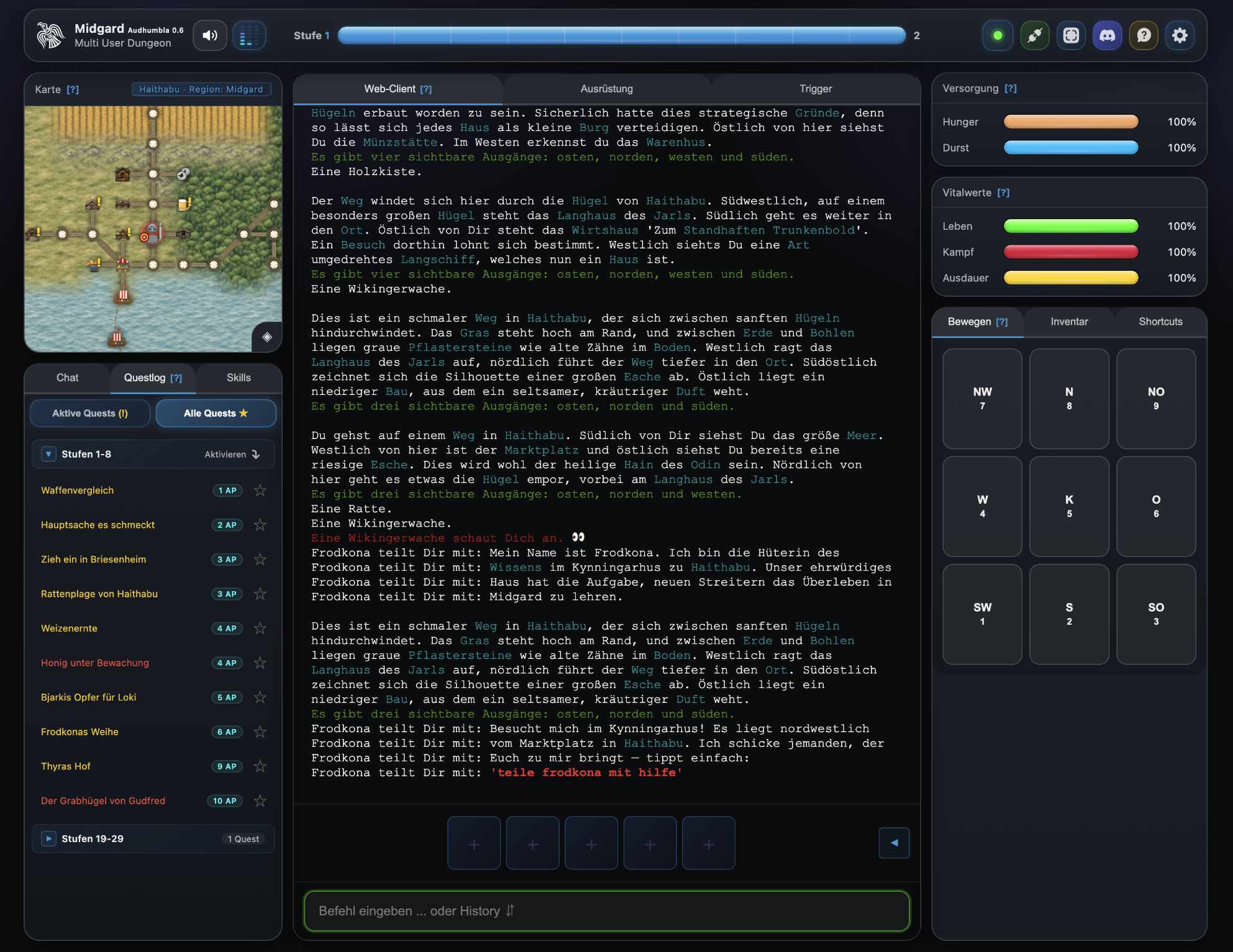
12.6 Midgard MUD — Norse Sagas in the Browser
The Midgard MUD web client — a modern MUD in the browser with coloured text, integrated map, sound design, and inventory panel.
Image: midgardmud.de — Free to use, provided a visible link to midgardmud.de is placed alongside the image.
An example that MUDs have not remained stuck in the 1990s is Midgard MUD — a modern German-language MUD that launched in 2021 and carries the LPMud tradition into the present.
Midgard is set in a world of Norse mythology: Vikings, gods, runes, sagas. Technically, it runs on LDMud 3.6 and offers a full-featured web client in the browser — with coloured text, integrated map, sound design, inventory panel, quest tracker, and even a 3D equipment view.
What makes it special: Midgard combines the text-based depth of a classic MUD with the accessibility of modern web technology. No download, no setup — simply open midgardmud.de/play and start playing. At the same time, the world remains entirely text-based at its core: every room, every NPC, every quest is hand-written.
Midgard shows where MUDs can go in 2026: not as nostalgic time capsules, but as modern, browser-based online worlds that unite the best of two traditions — the accessibility of graphical games and the narrative depth of text-based worlds.
12.7 Conclusion — MUDs as Foundation and Future
MUDs are not "old text games." They are the historical roots of everything we today call MMO, MMORPG, or online RPG: persistent worlds, group content, guilds, PvP systems, economy, moderation, and digital identity.
By 2026, MUDs have transformed their role: from mainstream pioneer to stable niche — and possibly back to trending format, as text, community closeness, AI-driven narratives, and browser accessibility unlock new strengths.
If you see MUDs merely as a precursor, you miss their essence: MUDs are a medium for world-building and community — and that is exactly what makes a good online RPG good at its core, whether with polygons or with words.
And then there is the roleplaying culture: the distinction between in-character (IC) and out-of-character (OOC), the emote system, consent-based RP, collaborative storytelling — all of this was developed in MUSHes and MUDs of the 1990s and is today the foundation of every RP server in WoW, ESO, or GW2. MUDs like Xyllomer and the RP MUSHes showed that text-based worlds can achieve a narrative depth that no graphical game can offer — because text does not limit the imagination, but unleashes it.
An overview of active German-language MUDs can be found on the German MUD List.
13. Timeline — Milestones in MUD History 1974–2026
From the beginnings of tabletop RPGs to AI-powered web MUDs — over 52 years of innovation history at a glance:
Year
Milestone
Significance
1974
Dungeons & Dragons
Classes, levels, dungeon crawl — the vocabulary is born
1976
Colossal Cave Adventure
First text adventure — the dungeon goes digital
1977
Zork (MIT)
Text adventure becomes a genre — Infocom follows
1977–79
PLATO Multiplayer (Oubliette, Avatar)
First multiplayer dungeon games — on closed mainframe network
1978
MUD1 (University of Essex)
First MUD on open networks — namesake of the genre
1980
MUD1 via ARPANET
First intercontinental online game
1981
BITNET founded
Academic network CUNY↔Yale — later 3,000 nodes on 6 continents
1983
Scepter of Goth
First commercial MUD — franchise model with paying customers
1984
MAD (BITNET, École des Mines)
First global MUD — ~10% of all BITNET nodes played; banned 1986
1985
MUD2, MUSE Ltd & Island of Kesmai
MUD2 + company MUSE (Bartle/Trubshaw/Dally); Kesmai on CompuServe
1986
Habitat (Lucasfilm Games)
First graphical multiplayer world — precursor to Second Life & Roblox
1987
AberMUD (Alan Cox)
First portable MUD in C — ran on Unix systems
1988
GemStone (Simutronics)
Most successful commercial MUD on GEnie (from 2003 as GemStone IV)
1989
TinyMUD & LPMud
Social MUDs + programmable worlds — two lines
1990
DikuMUD & LambdaMOO
Action-RPG formula + user-as-creator revolution
1991
Neverwinter Nights (AOL)
First graphical online RPG — MUD-graphics hybrid
1992
MorgenGrauen (Uni Münster)
Largest German MUD — German scene flourishes
1992
Snow Crash (Stephenson)
"Metaverse" term coined — inspired by MUD/MOO culture
1993
"A Rape in Cyberspace"
LambdaMOO incident — online governance becomes a topic
1994
Jurassic Park MUD (Korea)
20,000+ visits/day — Asian MUD scene explodes
1995
zMUD & 600+ active MUDs
Golden age — specialised clients and boom phase
1996
Bartle: "Hearts, Clubs, Diamonds, Spades"
Player type model defines MMO psychology to this day
1996
AOL flat rate
End of pay-per-hour — forces subscription models
1997
Ultima Online, LDMud, Tibia & Achaea
Mass MMORPG + LDMud driver + Tibia (CipSoft) + IRE/Achaea
1998
Lineage (NCsoft, Korea)
3.25M subscribers — Asian MMO era begins
1999
EverQuest
DikuMUD in 3D — the raid era begins, "EverCrack"
2004
World of Warcraft
12M players — MMORPG goes mainstream
2008
Mudlet & LDMud handover
Open-source client + German dev team takes over
2017
LDMud 3.5.0
Major update — German MUD infrastructure modernised
Amy Bruckman: "MOOSE Crossing: Construction, Community, and Learning in a Networked Virtual World for Kids" — Journal of the Learning Sciences 9(3), 2000
Edward Castronova: "Virtual Worlds: A First-Hand Account of Market and Society on the Cyberian Frontier" — CESifo Working Paper No. 618, 2001
Bartle, Richard A.: Designing Virtual Worlds. New Riders, 2003. ISBN 978-0-13-101816-7 — The standard reference on MUD architecture and virtual world design, by the co-creator of MUD1.
Turkle, Sherry: Life on the Screen: Identity in the Age of the Internet. Simon & Schuster, 1995. ISBN 978-0-684-83348-2 — Examines identity formation in MUDs and MOOs; one of the first academic works on the topic.
Dibbell, Julian: My Tiny Life: Crime and Passion in a Virtual World. Henry Holt, 1998. ISBN 978-0-8050-3626-0 — Narrative account of life in LambdaMOO, building on the famous "Rape in Cyberspace" essay.
Castronova, Edward: Synthetic Worlds: The Business and Culture of Online Games. University of Chicago Press, 2005. ISBN 978-0-226-09627-8 — Economic and sociological analysis of virtual worlds, from MUDs to MMORPGs.
Taylor, T.L.: Play Between Worlds: Exploring Online Game Culture. MIT Press, 2006. ISBN 978-0-262-20163-6 — Ethnography of online gaming cultures with roots in MUD research.
Koster, Raph: A Theory of Fun for Game Design. Paraglyph Press, 2004. ISBN 978-1-932111-97-2 — Game design theory by the former lead designer of Ultima Online and Star Wars Galaxies, shaped by his MUD experience.
Yee, Nick: The Proteus Paradox: How Online Games and Virtual Worlds Change Us. Yale University Press, 2014. ISBN 978-0-300-19040-2 — Research on player behaviour and self-perception in virtual worlds.
Pearce, Celia: Communities of Play: Emergent Cultures in Multiplayer Games and Virtual Worlds. MIT Press, 2009. ISBN 978-0-262-16257-9 — How communities self-organise in online games, from MUDs to Second Life.
Penton, Ron: MUD Game Programming. Premier Press, 2003. ISBN 978-1-59200-147-0 — Practical handbook for the technical development of MUD servers and clients.
Shah, Rawn & Romine, James: Playing MUDs on the Internet. Wiley, 1995. ISBN 978-0-471-11633-4 — One of the first popular books on MUDs, written at the height of MUD popularity in the mid-1990s.
Dellwig, Ingo: OOP — Der einfache Einstieg in die objektorientierte Programmierung mit LPC. Markt & Technik, 2000. ISBN 978-3-8272-5804-8 — German-language textbook on LPC programming for MUD developers.



.jpg)